Following up with the post I made about mayas, metallurgy as a way to gauge civilization advancement becomes even more ridiculous the longer you stray away from the typical regions (again, Europe and occasionally part of Asia). We got the example of the North Sentinel people!
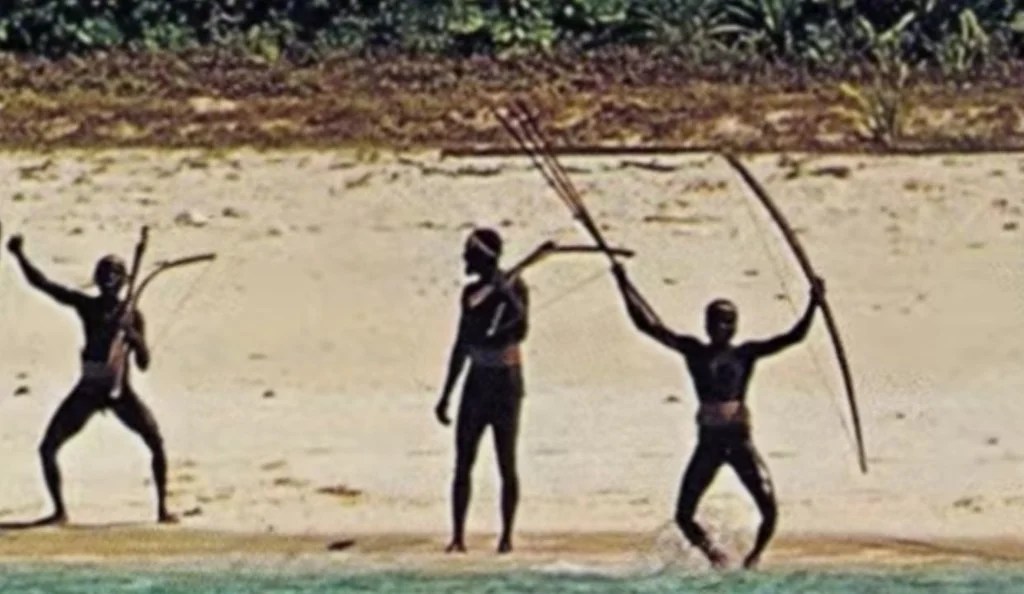
For anyone who doesn’t know about them, the Sentinelese are an isolated tribe located in an Indian island that managed to keep their ancestral way of living with zero changes. They are hostile to outsiders, and few ones that have managed to reach the shores have been swiftly killed by their arrows. The island is protected by India government, and very few contacts have been made. One day I will try to do more research and make an article talking about them, beyond the typical story of isolation and (probably justified) aversion of outsiders, but that’s matter for another time.
Their ”advancements” have been stagnant for millennia. Bows and arrows are their most complex weapons, they discovered how to make fire, crafted canoes able to navigate around the island at most… and little more. Not like they need to change, there’s no pressure to modify such lifestyle1. They’re probably sedentary just because they are isolated in an island, and have been for the last 60.000 years or so. So, essentially… a Stone Age civilization.
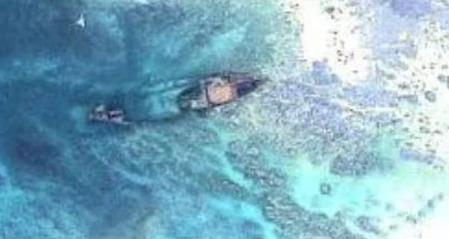
Well, I lie. In 1991, a ship called Primrose got wrecked close to North Sentinel island. The Sentinelese quickly visited the intruder with their small canoes (not made to travel long distances, unlike the ones the Maori people used in their migrations, to name an example).
To the left, a bird’s-view photo of the wreckage.
The surprising thing happened about a decade later. New footage tells us they are using metallic tools now! All their ways of living remain the same. The boat has not sparked any change in their attitude, their customs, whatever those might be, have no visible changes. No different clothes nor lifestyle. Only change is that the tip of their arrows and spears now is made with pointy bits looted from the shipwreck, and then sharped to their preference by themselves.
Very well, then. Following the ”age of metals periodization”, we should stand and give a big handshake to our Sentinelese friends. According to the traditional standard, they have gone from ”unremarkable hunter-gatherers” to the iron age! No, wait, the ship was made of steel! They are past the age of metals, already! It’s a given they will soon have an industrial revolution, even!
To my own admission, I’m being biased, maybe unfair, even, and I know nuances about ”civilization progress” (take that term with a pound of salt, please) are not based on metalworking alone anymore. But for ages it has been shown as the true breakthrough that made some cultures hegemonic, and it seems that such myth doesn’t hold together nowadays.
Every culture and civilization is different, and no one is truly above the others, for all the flaws or merits they may have. Sentinelese have Babylon beat in metal quality. Babylon way of organizing cities is better than Picts’. But Picts have a far more sustainable society than the current Globalized World. But the Globalized World…
…see how absurd is it?
What I’m trying to say, is that there is not a preset way of ”advancing”. Development may happen in such a wide array of ways that it’s objectively near-impossible to discern it.
The Mayas built great pyramids and literature advanced enough that only an elite caste of priests and noblemen could read and write it, but metallurgy wasn’t widespread until their later days of glory as a civilization (IX-X century CE). Meanwhile, the ancient inhabitants of the British Isles were well into the bronze age far, far before, at around XXV century BCE (over 3000 years sooner!) yet their societal organization and capacity for monumental construction wasn’t anything incredible in the grand scheme of things. Who’s more advanced, then? Who’s to say the spiritual corpus of the Sentinelese isn’t one of a kind, or that their -mostly- undeciphered language isn’t a new paradigm of communication? Even if that ends being not the case at all, would it make them inherently worse -or better- than the rest of the world?
Is a neolithic civilization that managed to achieve peace and stability, and has good relations with it’s neighbors more primitive or more developed than another one that started industrial revolution, but is submerged in constant wars that cull it’s population by the hundreds of thousands every few decades?
My personal answer is: why should we care? Advancement is not a benchmark to be desperately reached, and not always translates into better living conditions (if anything, technological progress could be potential to live better, but that’s not what we’re talking about here, and potential is often not the material reality. I invite civil discussion around this topic, since I’m sure it’s worth debating over it. That’s what history is about, anyways, debating over the facts to reach conclusions!
Appreciate every trace of humanity by what they are on their own, and not compared to others.
- As a matter of fact, I have also read they were more receptive to the world around them, and even visited nearby territories until as recently as 200 years ago or so, until the first colonizers arrived from Europe. A series of misunderstandings that I have yet to investigate further, and the general tone deafness of the outsiders, made the Sentinelese extremely wary of foreign presence ever since, barring very little and recent exceptions. ↩︎
 Crodur - Glimpses of our world
Post your thoughts!