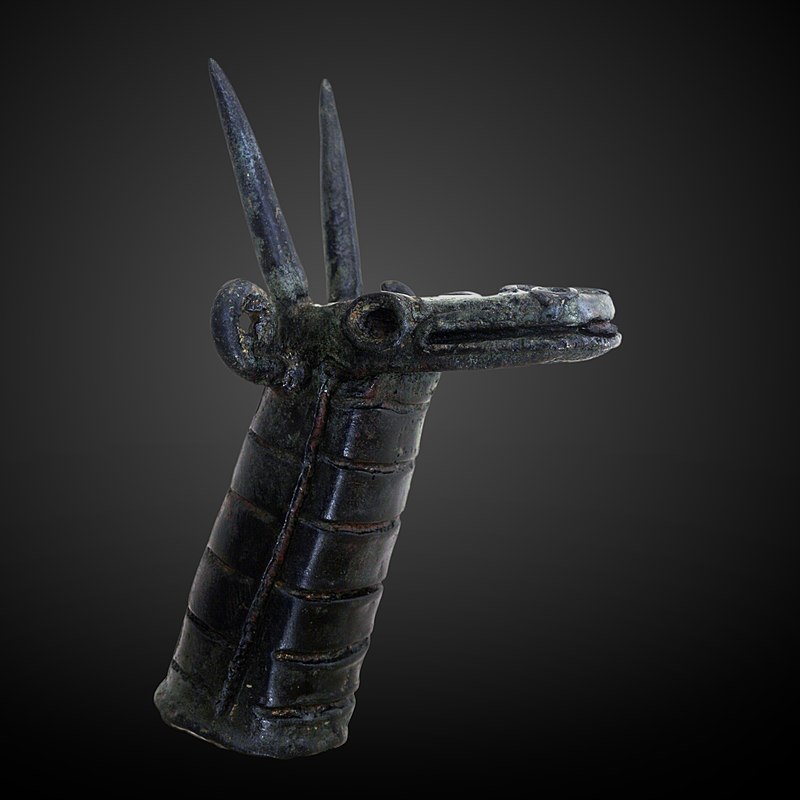
The Easter Island -aka Rapa Nui, as it’s homonymous natives call it- is famous for it’s colossal Moai Heads, of immense caliber, weight, and craftsmanship. That’s, however, only one of the many wonders these people produced. The Rapa Nui culture of (relatively) recent settlement, most experts agreeing their arrival must have happened around 900 CE. To put it into perspective, by that century:
- Western Roman Empire was long gone, dissolving almost 500 years before (476 CE).
- Maya civilization was already close to 3000 years old (since c. 2000 BCE).
- Egypt’s Giza pyramids were already over 3400 years old! (finished in 2500 BCE).
- Writting (as in, the capability of composing texts) was over 4000 years old (First spotted in Sumer, in 3100 BCE).
The Rapa Nui culture was revealed to the outside world in late XVII century, and the island ended being formally colonized during the XVIIIth. But here’s the kicker: despite the fact that natives were very much present at European’s arrival, the height of their civilization was long gone. Modern estimations point a major crisis started in XVI to XVII century, only a few generations before the westerner’s arrivals.
What remained of it, was a distant echo of the past. Only a few thousand natives that barely managed to resist increasingly harsh conditions. In less than 200 years, that mysterious crisis forced the Rapa Nui to leave behind an advanced architecture, a socially complex society, and even an actual written script! And that’s without mentioning the foreign diseases that were brought in, and the (sadly common among the colonized) harsh treatment they got. All in all, many mysteries were left behind, and only in the last decades, we’re starting to understand how magnificent was the past of these peoples.
That’s not, however, an attempt to devalue the ”late” natives. They still maintained a very rich oral tradition, defined mythos and overall, a full identity worth mentioning and treasuring. We focus more on the fact that they were remnants of a MASSIVE societal collapse.
In this article, we will discuss and speculate over their origins and the height of their civilization (X to XV centuries, mostly), since those are all lengthy enough to keep us occupied. Specifically, we’ll be talking about the famous Moai heads, and what’s so mind-boggling about them. In next entries, we’ll get into detail with the rest of their tangible heritage, possible causes of ruin and decadence, and what remained and resisted those conditions.
Origins of the Rapa Nui
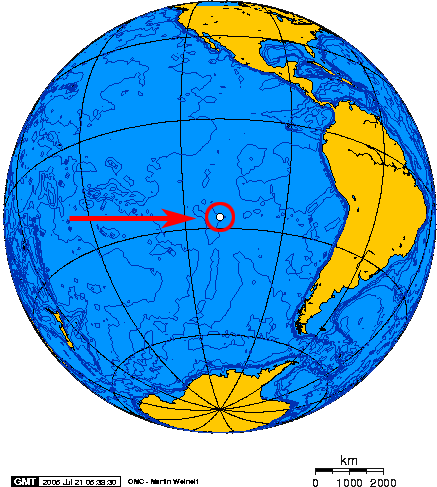

Like many other cultures of the Pacific ocean islands, those who would eventually be the Rapa Nui arrived somewhat late to their territory. As the image above shows, the second migration of Pacific islander natives would only come to be between the seventh and the twelfth centuries CE. The vastness of the ocean, with so few islands sprinkled in-between made the efforts to claim these islands difficult. Remember that Europeans only managed to reach the Americas far later, having much more durable ships tailored for the longest and harshest trips.
It’s speculated that fortuitous ocean currents propelled them into the island at some point. That would explain why colonization by natives was somewhat slow, yet constant. One can only wonder how many previous (and later) expeditions would be lost to the storms and to the unforgiving waters… The late Rapa Nui had oral recounts of their origins (that I would love to explore at some point) stating they came from the mythical island of Hiva, which geographers link to the Marquesas islands.
We really need to remark how isolated the Eastern Island is. The closest landmasses are the Pitcairn Islands, at 1200 km (750 mi) of distance. The aforementioned Marquesas, the most likely candidates, were at a vertiginous distance of 3500 km (1250 mi) from Eastern’s shore! To put it into perspective, that’s over the maximum distance between north and south of the entirely of India, all water!
Which explains why no additional waves managed to arrive for centuries, and most importantly, why the Rapa Nui didn’t leave when things turned grim: After centuries of sedentary life, in such an isolated and inaccessible island… they simply couldn’t. It was a near impossible feat. I encourage my readers to open Google maps, put it over the island, and then try to spot the nearest points, to get a visual idea of the situation.
The legend of Rapa Nui tells about an ancient king that arrived with his extended family to this destiny. It’s not very different of what likely happened in that specific part of the tale, but probably the natives were far more populous than a single family or two, led by that mythical chieftain or leader.
Another evidence that sustains that a large group arrived at once, is the fact that they brought many foreign species (animal and plant) with them, which arrived safely and prospered.
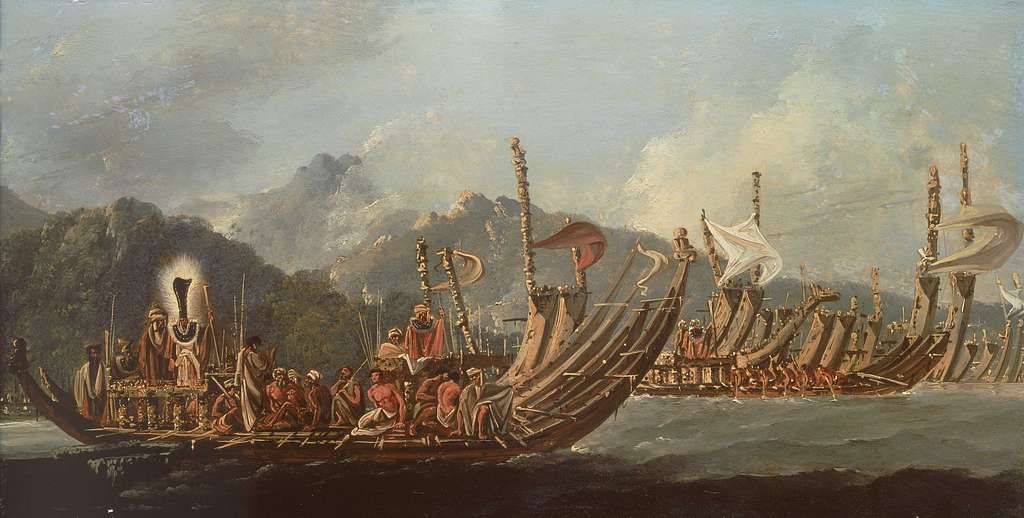
Forget the stereotype of flimsy, tiny canoes with barely enough room for it’s crew to row. They had to come in large ships, with room for animals, worker’s families and food reserves among other commodities. It was a huge endeavor for them to take this expedition on, no doubt about it.
To the left, ”War Galleys at Tahiti” (1772) by William Hodges, an artist that got to see Polynesian boats in a British expedition.

You may be thinking, ”when will be get into the theories of South American contact, and the speculated, consecutive migrations to the island?”. I’m afraid we will not, at least not today (maybe in the future…). Not only those are irrelevant to the focus of this article, but also they’re so long to dissect and analyze that it would occupy far more than what we aim to cover as of now. They’re worth an space of their own in the form of a different publication. That being said, let’s get to the point.
Societal highlights
As we said, the Rapa Nui quickly developed a very complex and particular civilization, of which we have very scarce traces, which is again surprising, considering that only a few centuries ago everything unraveled. Let’s check one of their major achievements.
Moai statues
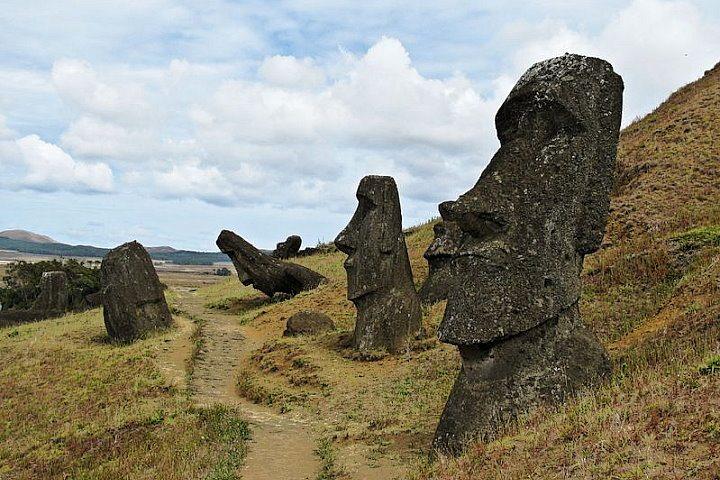
Of course, we’re starting with the most iconic part: the colossal heads spread all around the coast. The Moai statues are one of the latest landmarks built by the Rapa Nui, right between the 1200s and 1600s, and there were over a thousand (1044 preserved ones as of nowadays).
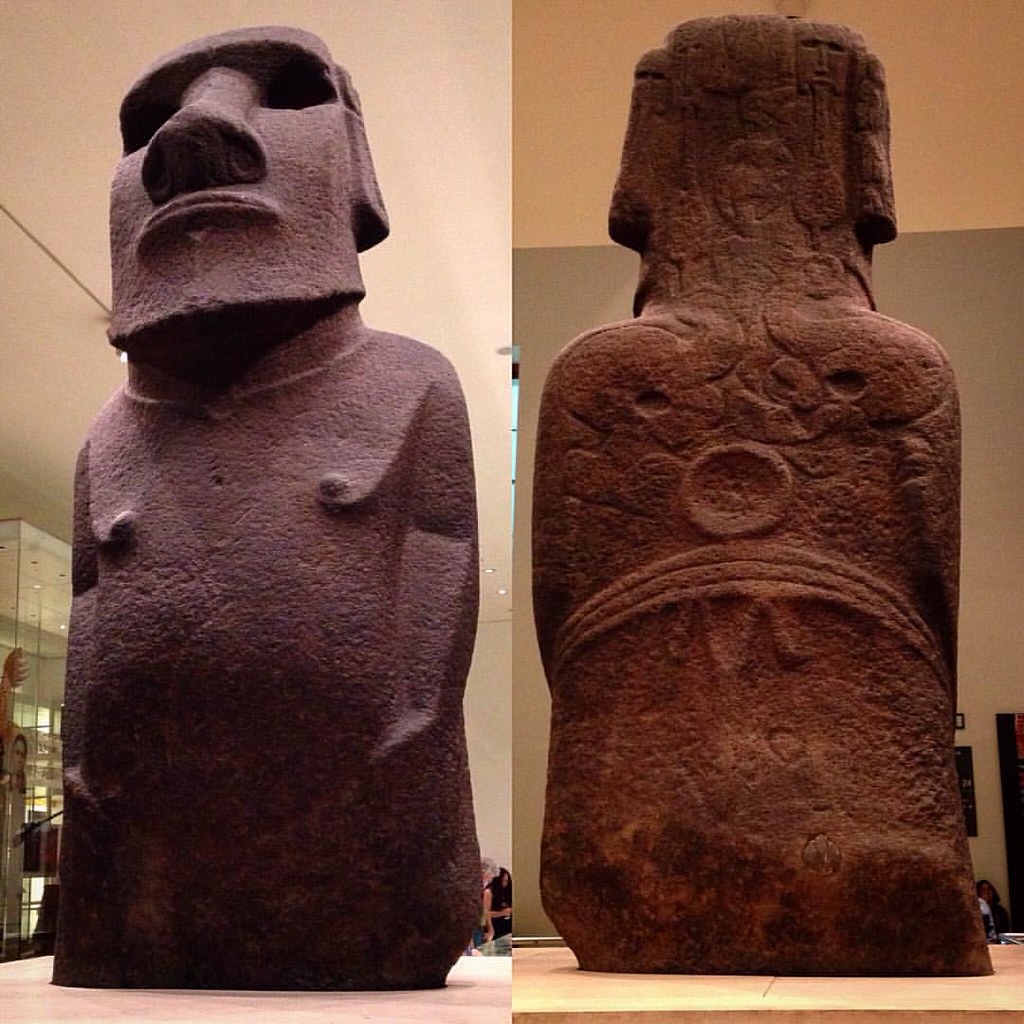
To the right, one of the many sculptures unearthed. Notice the presence of a full body and some sort of glyphs engraved on it’s back. It was carved out of basalt using stone tools, and it’s weight exceeds 4 tons (almost as much as an adult African elephant).
Many also had the Pukao, that iconic red cap. It’s actually supposed to represent their hair, tied up in a top knot a-la Polynesian style!
Do notice that the last of those dates of construction coincide with the beginning of their collapse, and the beginning is far later than their arrival, at least 3 centuries afterwards, to be more precise. This helps us reach three conclusions:
- Before the Moai were built, there were three or four centuries in which they were still consolidating their reign. That means they were the product of a Golden Age of sorts, coinciding with the height of their territory.
- During the first centuries, their infrastructure and logistics (related to building the Moais) rapidly exceeded that of the rest of the Pacific Islanders, maybe due to abandoning their nomadic lifestyle once they settled into the island (good luck going anywhere!), therefore having a different set of priorities than other natives.
- While maintaining traditions common (and traceable) to those of the estranged Polynesians, they developed a cult on their own with their particular rites and traditions. This is worth putting emphasis in, there’s no other construction like the Moais in the entirely of Polynesia, their craft was an entire straying from other, once closely related groups in the Pacific islands.
What we’re they made for?
The most common, accepted theory is that the Moais were made as a tribute to ancestors, representing their effigy for ages to come. Upon close inspection, it’s possible to recognize differing traits between them, meaning each of them had to have a distinctive look, and thus correlate to a particular person.
However, there were only a total of 77 known Ariki (leaders of the Rapa Nui, the closest they had to kings), and that’s counting the ones that reigned after the civilization was forced into a regression, while there’s around a thousand Moais. Could that mean that their dominion was prosper enough, that not only kings, but also other high standing subjects (or royal family) got to have their effigy as ancestors?
That would also imply the Ariki were not the sole container of power, and there were other figures in the pecking order. Which means, their society could have been stratified and divided in several categories, instead of just royalty and the commoners! Their society is worth exploring, but for this article, we’ll stop there. For now, that is.
Moai properties
Before it one gets the impression that we’re stating the obvious, we should reinforce the fact that those heads are a seriously big deal, literally and thematically; take in account that some of them were REALLY huge. The ones sitting at 4 tons (like the example provided in the photo above) were on the lower end. Some of the heaviest heads were erected at above 70 tones, which is around half the weight of the Statue of Liberty. And unlike the later, which was a wonder of a new technological paradigm, the Moais were made with… just sharpened stone and obsidian tools. Simply astounding.
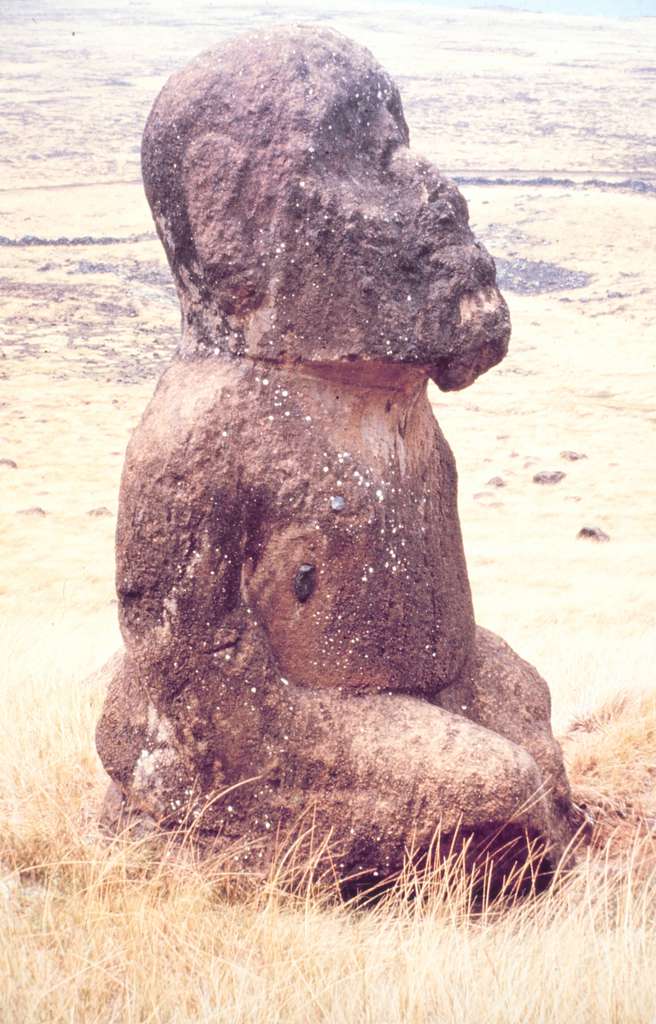
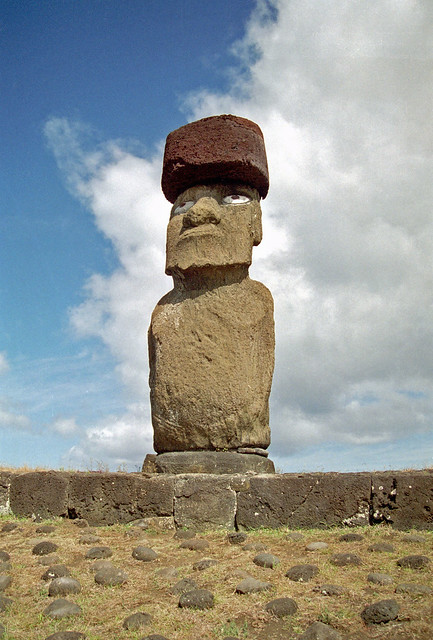
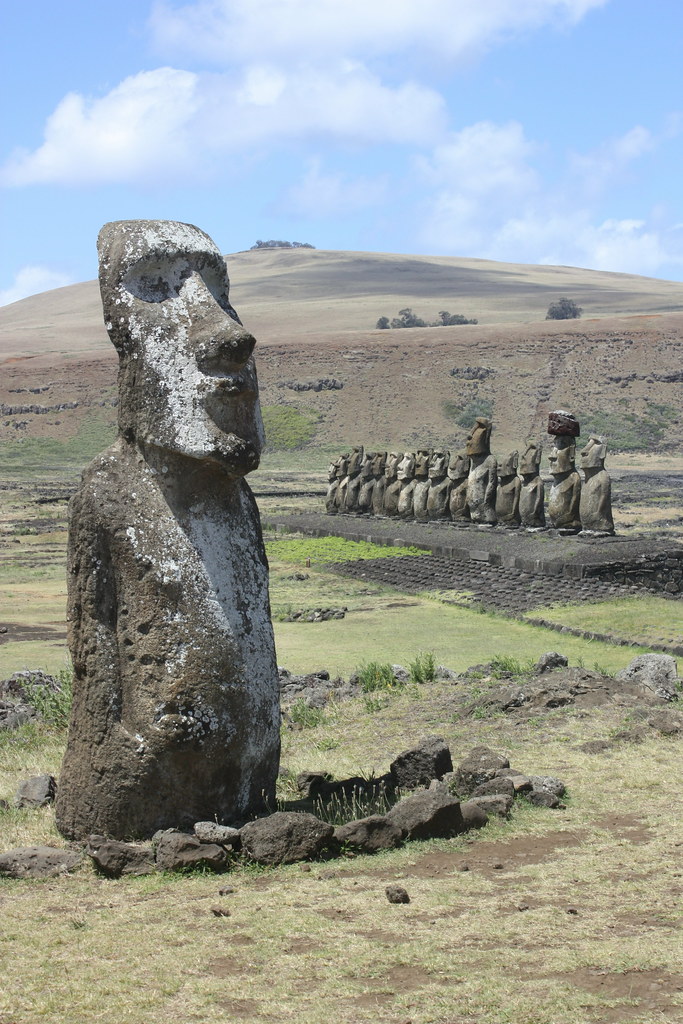
Some different Moai types, pictured from left to right: Moai Tukuturi (3 meters tall), Moai Ahu Ko Te Riku1 (5 meters), Moai Ahu Tongariki (8 meters) and Moai Paro (collapsed, formerly 9 meters tall and 80 tons heavy, making it the biggest among the erected ones). Notice the decorated eyes in Ahu Ko Te Riku, made with white coral and obsidian. It is believed all Moais had them at one point. (Could the differing sizes have been assigned to people of different importance in their kingdom? Was it just an stylistic choice?)
Some of the Moai also had engravings on their backs, as we have shown above. What they mean is a mystery. They aren’t part of their written script, even if their shape could look like that of a text. It’s clear they’re symbolic and there was a clear intention to put them there, where an important ancestor is represented. Theories I have read link them to the fertility of the ground, as a pray for prosperity. Could be that, maybe a symbol linked to a particular ancestor, or a third, unknown reason.
The fact that all they had was such rudimentary tools and their own stonemasonry knowledge, can only mean their society had a very vast and complex network of workers to be able to gradually cut such massive pieces. They could afford to spend great amounts of time, energy and resources (human and material) to build them, and still function as a society for a while. But that’s not the most intriguing thing…
…how did they even move them?
Those heads were pushed to far distances, from the quarries (located within the central volcano crater Rano Raraku, pictured below) to the coasts, sometimes entire kilometers! How could it be?
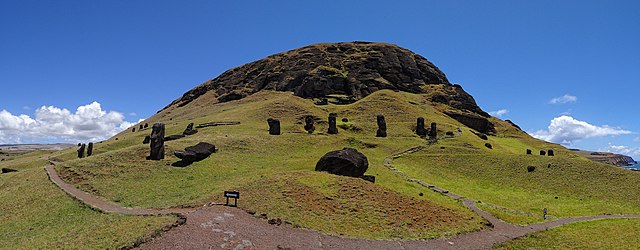
When the Europeans asked the descendants of those who accomplished such a feat, how could they possibly have moved such gigantic pieces with ”stone age2” technology, they just said ”the Moai were awoken by a Shaman, who made them walk to the coast, and then they installed themselves there”.
What is more baffling, is that they could be technically right! For ages, anthropologists have tried to come up with a reasonable transporting method, taking into account the limitations of the Rapa Nui ancestors. Until they reached a conclusion: They, indeed, could have made the statues ”walk”.
By tying a rope around their heads, and rocking them left and right, the statue can be moved at a slow, yet steady pace! Look at this video below demonstrating this almost cartoonish looking achievement, produced by National Geographic.
https://www.youtube.com/watch?v=YpNuh-J5IgE
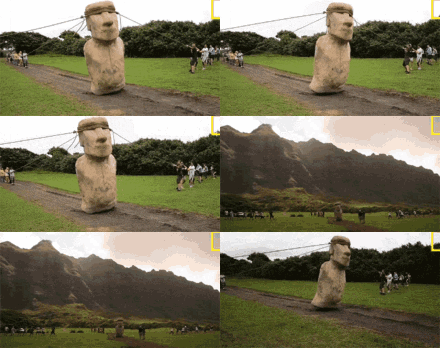
This, however, has only been applied to the smaller models, the one featured in the clip being around Ahu Ko Te Riku’s size. It’s a great stretch to think it would work with the most colossal of them. But it’s still a step closer to figuring it out! It’s also a great lesson at paying attention at what natives have to say about their own world and how they explain it’s phenomena.
An argument could be made that they were told the process of moving them by the latest craftmen that remained before their kingdom ”fell”, and over the latest 2 centuries before their contact with the outside world, it slowly morphed into a literal metaphor. There’s words of truth in everything, if one looks with the correct approach!
So, this pretty much covers the article for today, I’m afraid. I wanted to talk about their intriguing written script, the still undeciphered Rongo Rongo, but that would make this text too lengthy, so it will have to wait until the next publication. Let’s take it easy and steady, no?
Until then!
Sources I consulted:
- Stevenson, C. (2013). Prehistoric obsidian exchange on Rapa Nui, published in https://www.researchgate.net/publication/271672313_Prehistoric_Obsidian_Exchange_on_Rapa_Nui
- https://en.wikipedia.org/wiki/History_of_Easter_Island
- https://www.easterisland.travel/easter-island-facts-and-info/moai-statues/
- https://www.bradshawfoundation.com/easter/sentinels_in_stone/index.php
- https://phys.org/news/2019-12-unearthing-mystery-easter-island-moai.html
- Photo courtesy of https://www.flickr.com/photos/monchan/140870539 whom all credit belongs to ↩︎
- A quick rant about the use of metals as a development measuring tool, click here ↩︎
 Crodur - Glimpses of our world
Post your thoughts!