A recurring joke among those interested in classic History (such as myself) exists around the Roman and Greek mythos, specially how the later are depicted as an original creation, made by the Hellas1 natives, and/or immigrant waves that eventually settled in, and the Romans just… claimed it as their own, slapped a couple names on the acquired Gods and… that’s it, a new religion emerged! The Greek’s own work and merits, stolen by some opportunistic slouches.
That’s however, a very disingenerous interpretation of the facts, and it downplays Rome merits, creativity and integration of multiple cults, while it paints Greeks as the sole authors of the beings they worshiped. In today’s article, I’ll try to disprove this, and show you that things aren’t so black and white in the real world. And I’ll do it with the example of a well-known Greek God: The one and only personification of the Sun: Helios!
Who is Helios?

As I said, Helios is who some Greek Polis (city states, the way the peoples of those regions organized) considered the incarnation of the Sun, a God that propelled himself with a horse chariot through the skies.
Depending of the interpretation, he either wore a shining crown (being the Sun himself), or pulled the sun with the chariot, being merely it’s driver. He was also the patron God of the Island of Rhodes and nearby settlements. He was adored since at least 500 BCE around that place. In fact, have you ever heard about the Colossus of Rhodes, one of the seven wonders of Ancient World? It was made after Helios himself! (to the left, an engraving made by Sidney Barclay recreating how the statue could have looked).
Anyways, remember those traits and date: 500 BCE, horse chariot, sun deity.
The Romans didn’t originally rip Helios from the Greeks, their Sun God (Elagabalus) was of Syrian origin, and only later they proclaimed Helios as the bearer of that role. They changed the name to Sol at some point (from Sollis, Sun in Latin), which tracks with Helios pretty much meaning ”Sun”. But that’s just a nitpick, so don’t pay much attention to it.
So, yeah, nothing new to the table, the Greeks pretty much invented a Sun God, and the Romans eventually decided to make that idea their own. That would make perfect sense… until something shocking was found.
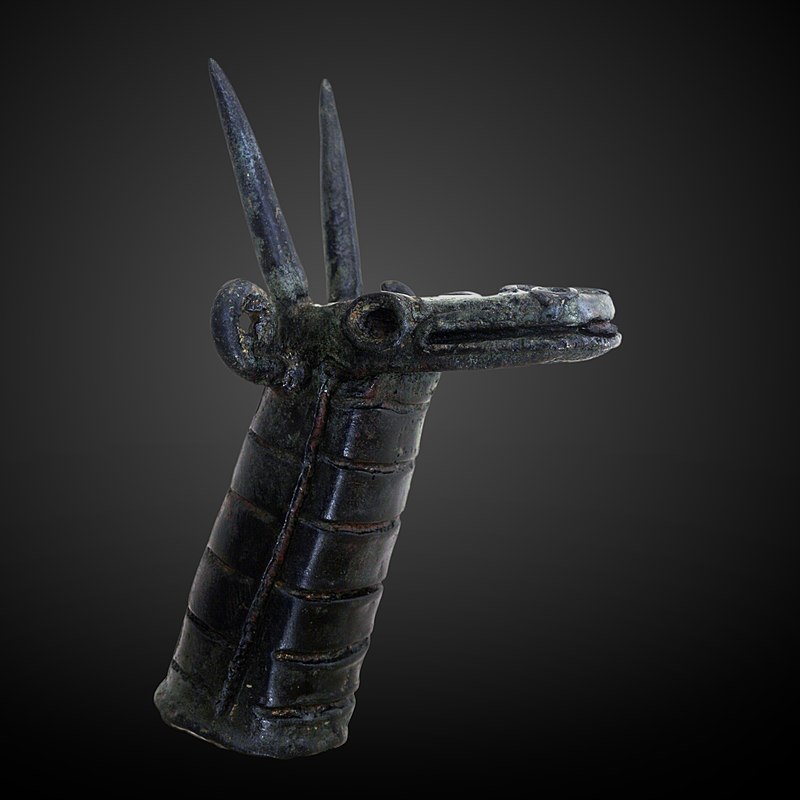
In 1902, an artifact was found in Denmark; it was named Trundholm sun chariot, after the plain it was found at. It featured a horse pulling what has been recognized as the sun, over two wheels, resembling a chariot or traction device. Vaguely similar to what the Greeks believed in Rhodes. It’s speculated that the object was made as an offering, and thrown into a lake millennia ago for religious or ritual purposes.

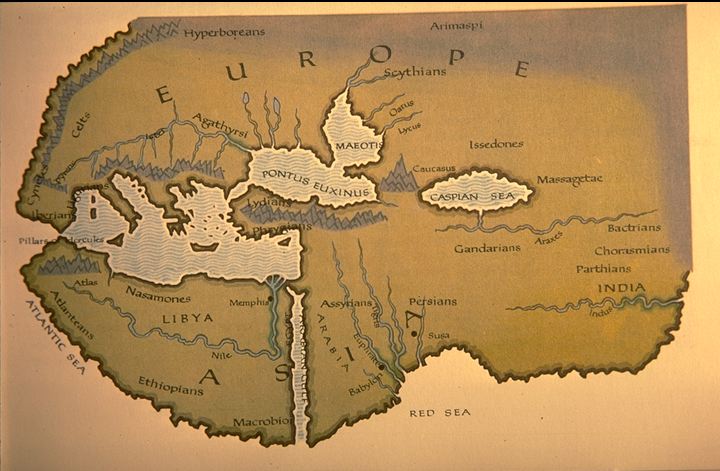
The shocking part comes here: Not only the Greek didn’t know that part of the world existed at all (even their mere, residual influence reached at most a couple thousand miles away from there at the closest point, check the map to the left, featuring the known world according to Greeks), but also, the Trundholm chariot is… from 1300 BCE.
That’s 800 years earlier than the first time Helios was adored in the Hellas, let alone depicted with a chariot! What does this mean?
One could think the cult of Helios is probably older than we tought, and somehow, by multiple trading routes it eventually reached Denmark from Greece, like a broken telephone game. Or maybe, it could be a total coincidence, right? But going by that angle only makes things worse… because the Trundholm chariot is just one among many, many uncomfortable coincidences.
India does also have his own Sun God (named Surya), whose carriage is pulled by seven horses. Even further north than Denmark, the Sun (Sunna) , too, was pulled by two horses, named Alsviðr and Árvakr. Remember, Greeks just didn’t have the most remote idea what was going on up there, anything above the Azov and Black seas was just chalked as ”Hyperborea”, a land were allegedly strange human groups, and even mythical creatures resided.3
Then, there’s the chronological issue. The island of Rhodes (and Hellas as a whole) didn’t hold beliefs on Helios, none that we can track or follow. If the Chariot of Trundholm was a Greek influence, why is there no evidence of that influence existing on Greece, where it should have been far more widespread?
All those little pieces of chronology and places we have gathered, not only disprove Helios as a Greek creation (at least not solely)… but give us a revealing clue… Could it be that Helios, Sunna, Surya… are all part of an older, common origin?
The Proto-Indo-European expansion
The idea of deities, language remnants, and other vague traits found in many places of western Eurasia has been around for a while. Because, indeed, Helios is just one of many examples that follow such trend. Over the last two centuries, anthropologists have started to piece together what could be the origin of most of the native cultures of Europe, Middle East and the Westernmost part of Asia, and there’s sustainable evidence to back it up, every day finding more and more patterns that can be linked to a common root: the Proto-Indo-European peoples, or PIE, to abbreviate.
The PIE were an hypothetical group of peoples that existed at around 3500 BCE, that shared an also hypothetical language the experts name the same way. Since this article is not about them (I may write something about them later), let’s summarize that we know barely nothing about them. Just by judging how languages, traditions, and customs have evolved since their earliest known instances, philologists have an educated guess of how the origins of all those aspects could have looked like. An example of how this works can be seen in the image below, were a proposal of how they pronounced ”2” has been made by closely following all the languages that come from the original PIE.

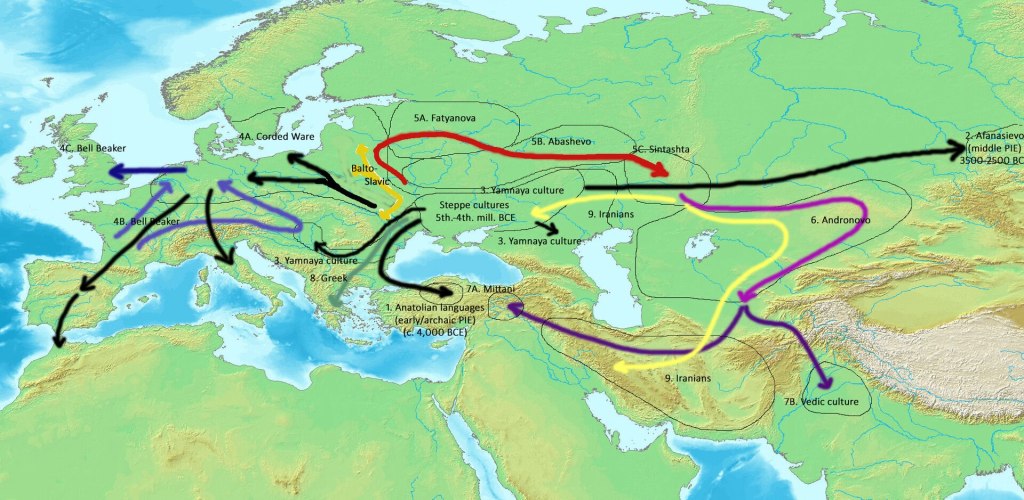
By compiling records and archaeological evidence, humanists have managed to loosely guess when the PIEs expanded and split, and when their original legacy slowly drifted apart. That explains why many parts of the continent have vaguely similar folklore, while not knowing about each other (since the original migrations went different directions thousands of years ago, and they had no written scripts to register it, making that an obscure event that eventually faded away).
Going back to Helios, we can vaguely pinpoint his cult origins and trace a thin genealogy of Gods, that ultimately led to his cult. Skipping PIE religion itself (or what has been speculated, by comparing splitting, later cults), the oldest solar deity is a Goddess, believed to have been called *Seh₂ul (don’t ask me how that’s supposed to be pronounced). Even that distorted name may sound familiar to those of you that are versed in European languages, it still sounds vaguely similar to ”Sole” (Italian), ”Sol” (Portuguese, Spanish) or even Słoneczny (Polish).
*Seh₂ul was an already chariot driving sun deity. It is believed his figure took that form right after the introduction of the wheel in the Caspian steppe in 3500 BCE (right when the first PIEs started their influence). That invention (and directly afterwards, the chariot itself) was quickly associated with the sun for many plausible reasons. Some of them, I speculate myself, could be:
- Like the Sun, it cycles through itself, doing a full loop and then starting over.
- The Chariot, pulled by the swift horses, was by far the fastest locomotion these peoples ever knew (and it would stay that way for millennia, to be fair). Which other device could cover something as vast as the sky in such little time?
- The element of novelty: The most cutting edge technology at the time, that changed forever the way the human groups moved and migrated, and made the Earth a little bit smaller for humanity, could have only belonged to Gods
The Indoeuropeans eventually split, as we said, and the groups migrated to many other places, like the graphic below displays. It also explains why plenty of other places, such as China or Egypt (that also had horses and chariots), didn’t have the sun chariot iconography: the Indoeuropean influence didn’t reach there, or arrived late and scarcely.
Skipping the many forms the sun Goddess turned into, we find her, in the Hellas predecessor, the Mycenaean civilization!
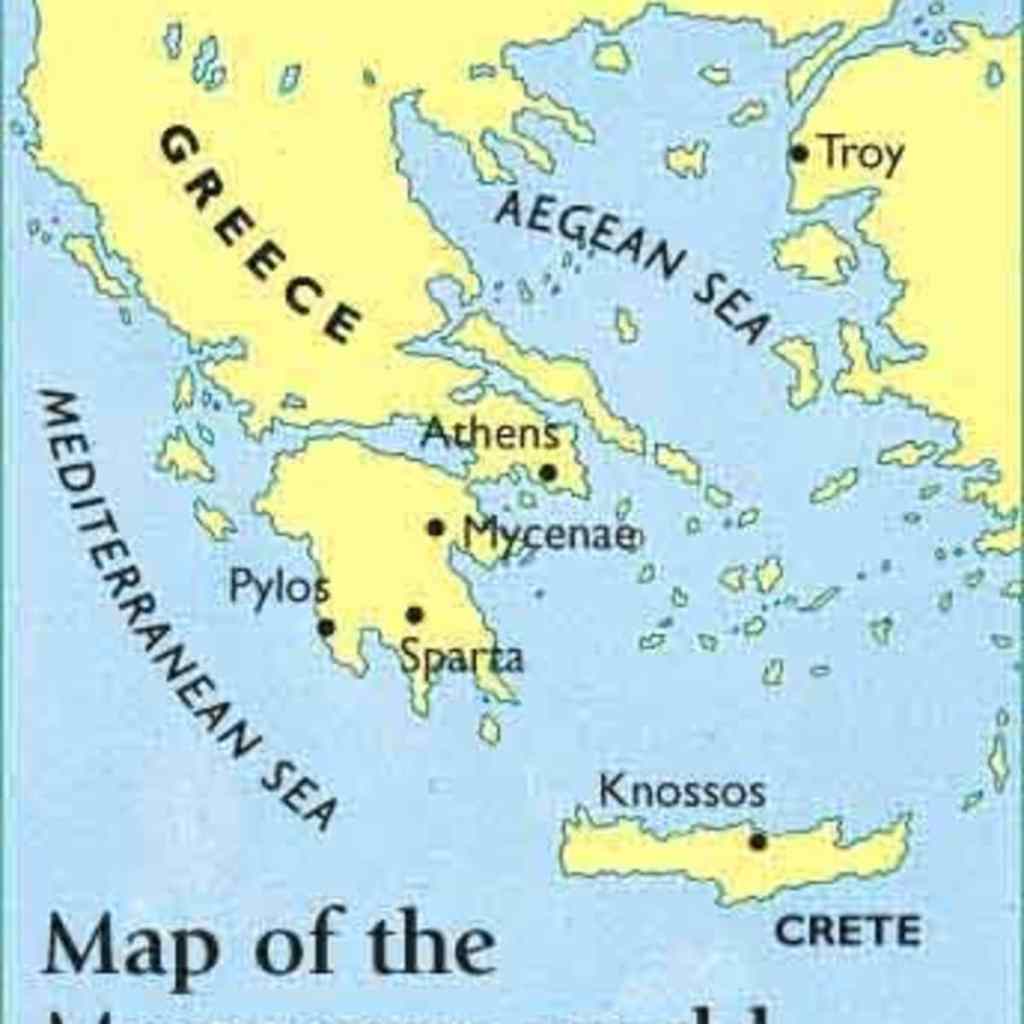
Located in the Peloponnese peninsula (To the left), Mycenae was home of many Gods the later Greeks (which in turn, where the product of many migrations and local natives colliding and merging into a new culture) adopted. They would expand from 1750 to 1000 BCE.
The Mycenaean possessed a written script called ”Linear B”, that has been successfully deciphered nowadays, and from which a few recorded inscriptions remain. Amongst those, there’s some of their Gods and how they called them…
Some familiar names pop in, already: Atimite – Artemis, the hunting Goddess; Pereswa – Persephone, daugther of Zeus… and lastly… *hāwélios is for the first time mentioned. Compare it to Helios, and you may see how one has derived from the other! Which altogether proves the Greeks as a whole started revering Helios as an outside influence, and it wasn’t (pretty much like most if not all the deities) a made up, 100% original thing.
By the way, for those of you who are curious, *hāwélios is written like this (in Linear B):
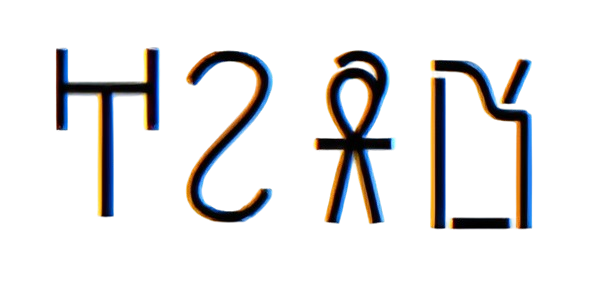
Where the Greeks copycats, then? And the Romans?
Not at all! What I’m trying to explain, is that mythology in real life is never a matter of pure originality. Gods, tales, folklore, are all made by piling the stories thousands of different voices have told, for hundreds or even thousands of years, and that have gradually changed as new generations added or removed details of the main narrative. The Romans have often been criticized for shamelessly ”stealing” foreign Gods and making them their own. In reality, they just did something similar than many other cultures, such as the Greeks and their Helios: They saw an outsider religion, took aspects from it that they liked, and integrated them, making those their own thing.
This is why, Helios, Surya, Sunna and many others, despite being essentially growths of the same root, are essentially separated Gods, that are as legitimate and original as any other belief, even when compared to the ancient *Seh₂ul.
The human nature is a collaborative, constant effort. Building on top of what our ancestors did, and making a foundation for the future generations to build upon in the direction they please. Like an enormous tree, with it’s many branches, some thinner, some wider, but all of them undoubtedly part of the same basis.
So, to summarize it quickly: Neither the Romans myths were exactly mere knock-offs, nor the Greek ones were unprecedented, isolated creations. And that’s a good, natural thing.
- In Classic Greek Ἑλλάς, the endonym the people of the different Greek settlements and regions of the same culture and similar customs and language used to call themselves. For example, Sparta and Athens citizens recognized each other as part of the Hellas, despite being at odds and even entering wars among themselves at times. ↩︎
- The picture was originally posted on https://www.flickr.com/photos/peterleth/albums/72157623981367698/with/4573751113 and it’s free to use under CC BY 2.0 license. ↩︎
- The Greeks often would speculate that many strange creatures lived beyond the territories they knew about. For example, southern Ethiopia was the land of the Akephaloi, headless men with a face located in their torsos. ↩︎
- CC BY-SA 4.0 https://creativecommons.org/licenses/by-sa/4.0, via Wikimedia Commons. Image free to distribute and share under the premise of addresing it’s source. ↩︎
Sources I consulted:
- https://crewsproject.wordpress.com/wp-content/uploads/2017/05/write-your-name-in-linear-b1.pdf
- https://en.wikipedia.org/wiki/Solar_deity#Solar_chariots
- https://en.natmus.dk/historical-knowledge/denmark/prehistoric-period-until-1050-ad/the-bronze-age/the-sun-chariot/
- https://starkeycomics.com/2019/11/01/indo-european-words-for-two/
- https://www.theoi.com/Titan/Helios.html
- https://en.wikipedia.org/wiki/*Seh%E2%82%82ul_and_*Meh%E2%82%81not


Post your thoughts!